
Beginning with an adult woman watching home-movie footage of a long-gone holiday, Aftersun chronicles the modern connection between memory and technology. Partly based on first-time director Charlotte Wells’ childhood, the film follows Sophie, a young parent who is viewing her past through home videos. Viewing footage of her final holiday with her father when she was only a child, Sophie finds new meaning in connecting to her troubled father and in a childhood she did not completely understand. Dealing with this narrative and its connection to memory, one of the biggest things the film does not convey to the audience is the fate of Sophie’s father, Calum. It is conveyed that this is the final time that Sophie sees her father, but it is up to the audience by seeing the clues for themselves in Sophie’s documented footage and memories to make their own conclusions for the troubled father’s fate. Memory is an important factor that plays into the narrative, recognising our development as we look back and reconsider the past, finding new connections to memories that cannot be understood until the relevant life experience has occurred. A clear focus as well is memories connection to technology, it reflects the modern times. Memory used to be something only a person could rely upon, thinking back to moments and slowly losing those memories with age, but with home movies and cameras, memories last forever and are now always there to be analysed for new meaning. That is where we find Sophie, stuck to her television screen, revisiting moments from her past for any type of answers for what happened to her father, years removed from the events, as her own baby cries in the other room.
No matter what a viewer decides upon for the fate of Calum, it can be inferred fairly easily that the man is troubled, and seems to be close to ending his own life, or at least considering it. There are clear signs throughout the film that he has little value for his own safety, from walking in front of a bus as it beeps for him to move, going to swim in the ocean at night by himself or doing handstands on the hotel balcony. A key scene for this point comes when Calum makes Sophie list the reasons why she shouldn’t smoke, forbidding her from taking part in a harmful way of life, but he proceeds to smoke himself on numerous occasions.
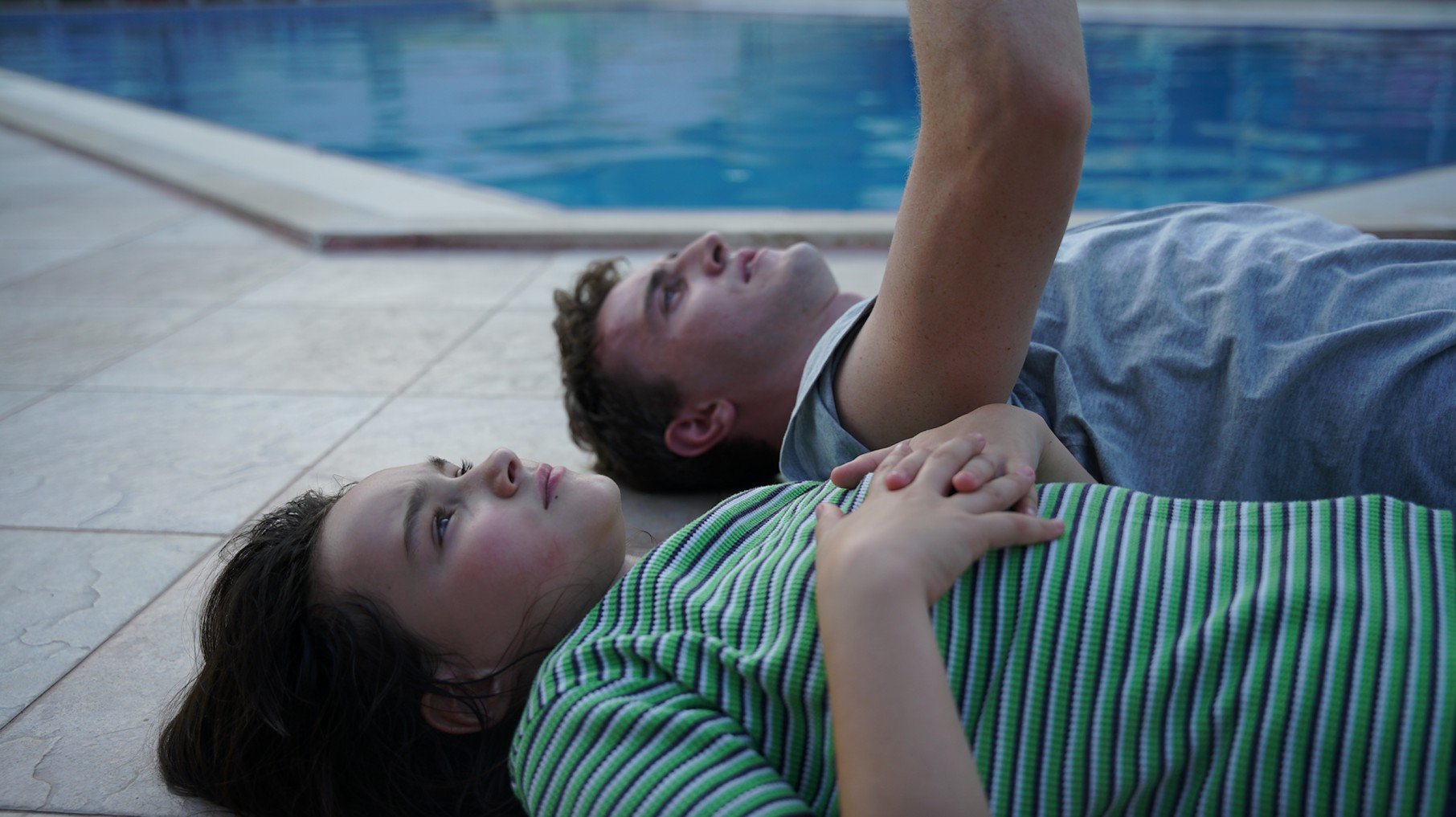
Young Sophie points out later in the film that he does not have the money to be making such luxurious purchases, after buying a expensive rug and a polaroid of both of them from a salesman, seemingly aware even at her young age that there is something amiss. These expensive purchases seem to connect to his lack of value for life, almost like he knows he will not be here soon and therefore does not need the money. These purchases instead become memories for Sophie, forming another connection the movie makes to memory, physical evidence also draws upon memories of youth. When showcasing adult Sophie in the long shot in her room, she appears sitting on a couch, with the rug her father purchased underneath. Sophie does not understand what happened to her father it seems, and that obsession to make sense of that trauma comes out in still latching onto the items that those memories are steeped upon.
When receiving the polaroid, the camera holds slowly as it descends towards it placed on the table, the image appearing slowly onto the frame. In the slow appearance of this image, it marks a movement for Calum, as he becomes part of Sophie’s memory, forever contained in the image. In this image, smiling to the camera, Calum remains as happy and youthful as he seemed to be for young Sophie in that moment of time. Though this happiness is not the full picture. Young Sophie describes her mood after an eventful night-out in the middle portion of the film, describing the feeling of coming home exhausted and sad, even though you have a wonderful day, you are still however consumed with a feeling of weakness and ache that its all over, the emptiness all-consuming. She essentially describes depression in its simplest terms, describing a feeling that Calum seems to feel often based on his reaction in the scene. The camera trails on the father in a medium shot, as he looks into the mirror, his face conveying the anger that he feels for himself, Paul Mescal delivering a solemn glare to camera as his daughter describes what he feels without being aware she is. The film very much tracks this anger coming from Calum, as he almost seems to make his decision across the film, whether he must go or he must stay.
When on a boat trip, Calum relays to Sophie that he hopes she will always be able to speak to him in the future, about drugs, boys, parties and more. He is giving a false promise that seems to not come true, begging the question whether he means this promise, or is he trying to convince himself that he should be around longer. It seems to be that he hopes she will speak to him even after he is gone, representing that memory keeps a person alive as long as you still connect with their memory. There are more instances where he seems to be thinking over his decision, various scenes being dispersed with footage of him looking over the footage that Sophie has gathered across the film. He’s watching footage shown previously, almost looking over the last footage he will see of his daughter before he makes his decision.
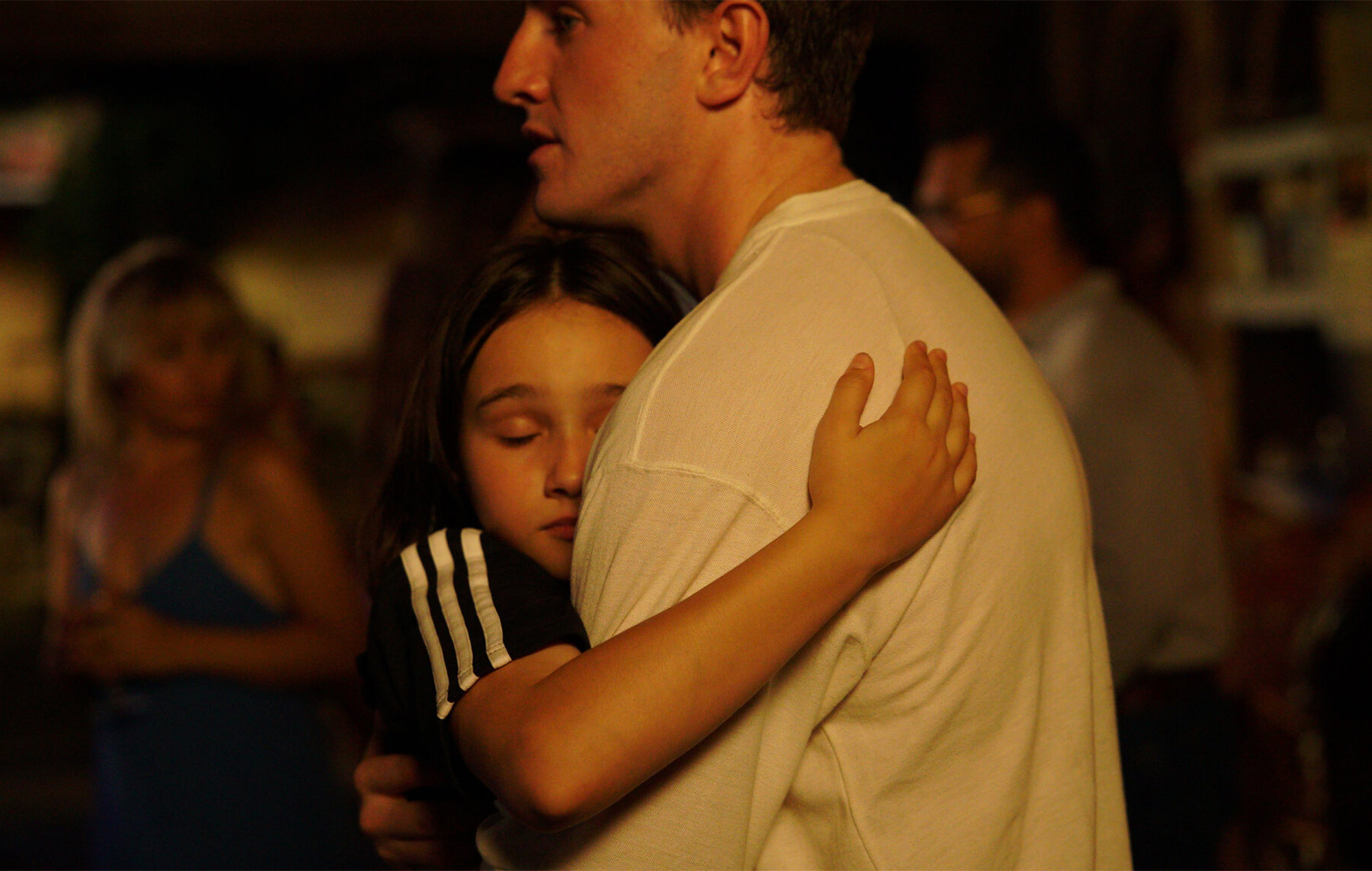
Memory becomes the reason for Callum’s choice, it becomes the one thing that can keep him with his daughter or can strip him away from the life he has made with her. The final act of the film however seems to culminate with him making his choice, as he cries with his back to the camera. The scene transitions from Sophie gathering a group of tourists to sing her father happy birthday, the diegetic audio transitioning from the happy sound of a happy birthday to his guttural cry, as his shirtless body rises and falls with each cry. This seems to lead to the assumption that he has made his decision, and the subtle change from happiness to sadness leads to the final sequences.
The film continuingly cuts to footage of Calum in what seems to be a nightclub throughout its runtime, contained completely in strobe lightning. These sequences feel very disconnected with the overall narrative until Calum and Sophie come to the last night of their holiday. Arriving back to the hotel after a night out at restaurant, Calum pulls Sophie onto the dance floor even though she is tired. She mixes between dancing and refusing to dance with him across the sequence, as the camera watches Calum dance without a care in the world and with a smile on his face in a point of view shot. The scene is matched with adult Sophie appearing in this strobe lighting-filled room, as she pushes through the crowd of people and comes face to face with her father, desperately trying to talk to him and hold him for any longer. The scene is paired with the diegetic music playing at the hotel, ‘Under Pressure’ by Queen. As she attempts to get closer to him, the music blares louder as her words are drown out by the tempo of the song. The words of the song convey a very clear meaning to the narrative, ‘this is our last dance’ conveys the final nail in the coffin that this is the last time these two family members will be together. The more powerful lyric however is when the film cuts between young Sophie and adult Sophie hugging Calum, as the film blasts, ‘why can’t we give love one more chance?’ Adult Sophie is gripping onto Calum as hard as she can, willing him to come out of her memory, wishing she would have danced with him more that last night but Calum falls back and the night ends. The next day comes and the two have arrived back in the UK, as the last camera footage shot of the holiday shows Calum filming Sophie walking away from him, turning around and waving multiple times. The return to natural footage comes as Calum puts away the camera, sighs and walks into the door behind me, the last thing seen being the flashing lights of the nightclub, as the door slams behind him. Calum exits the film to become part of Sophie’s memory, existing as a fragile memory that she will never completely understand, lost in an endless disco of other memories.
This is the tragic theme of Aftersun, it conveys memory as connected to technology, memory as collective and traumatic, memories’ connection to items but its true narrative is around the tragic uncertainty of memory. Once it becomes a memory, it will never be understood properly again, Sophie will never understand what happened to her father truly because she does not have all the answers, just like the audience does not.
 Rhys Reviews
Leave a comment